
When you receive a diagnostic report, it is easy to imagine that the process behind it is fairly straightforward. A laboratory takes your sample, runs a test, puts the result on a report and sends it to you.
In reality, there are quite a few steps between handing over a sample and receiving that PDF on your phone.
Someone has to register the patient. The right tests have to be attached to the right record. The sample needs an identity. Results have to be entered and checked. The report needs to be put together, reviewed and finally delivered.
And all of this is happening while the laboratory is dealing with dozens, hundreds or sometimes thousands of other patients.
This is where a Laboratory Information Management System, or LIMS, comes in. At its simplest, a LIMS is the software layer that keeps these different activities connected.
But what does that actually mean from a technical point of view?
 It begins with a record, not a report
The report is what the patient sees, but it is not where the process begins.
The starting point is usually the patient record.
When someone walks into a laboratory, their basic information is entered into the system along with the tests they need. That information then becomes the reference point for everything that follows.
This matters because laboratories can otherwise end up entering the same information repeatedly. A receptionist might record the patient’s details, a technician might receive them on a paper form, and someone preparing the report might have to type some of it all over again.
Every extra entry is another chance for something to go wrong.
A digital LIMS tries to avoid this repetition. The patient’s information is stored once and then connected to the rest of the workflow. The test order, billing information, sample and eventual report all relate back to that same record.
It is a fairly simple idea, but it changes how the whole process works.
The tricky part is connecting a physical sample to digital information
A laboratory is not completely digital. There is still a physical sample sitting somewhere in the building.
That sample might be a blood tube, urine container, tissue specimen or something else. The software needs to know that the sample on the laboratory bench belongs to a particular patient and is associated with particular investigations.
This is where sample identification and tracking come in.
Once the sample is registered against the patient’s record, the laboratory can continue updating its status as it moves through the workflow. The digital record effectively follows the physical sample.
This becomes increasingly important as the number of samples increases.
In a small laboratory, people may remember what is happening with individual samples. In a busier setup, relying on memory becomes unrealistic. A system needs to provide a consistent way of identifying what a sample is, what needs to be done with it and where it stands in the process.
That is one of the less visible jobs a LIMS performs.
A test result needs context
One of the easiest mistakes people make when thinking about laboratory software is assuming that it is basically a digital spreadsheet.
It isn’t.
A result is not useful by itself. It belongs to a specific investigation, which belongs to a specific patient. It may also need a unit, reference range, reporting format and other associated information.
Take a completely hypothetical result of “5.2”. On its own, that number tells us almost nothing. The system needs to know what was measured, how it should be expressed and which patient’s record it belongs to.
This is why laboratory systems use structured data rather than treating every entry as free-form text.
The point is not that the software replaces professional judgement. It doesn’t. The point is that routine rules can be handled consistently by the system, leaving laboratory professionals to concentrate on reviewing the information and making the decisions that actually require their expertise.
Then the report is assembled
By the time a report is ready to be generated, most of the information already exists somewhere in the system.
The patient’s details are there. The requested tests are there. The results have been entered. Other information, such as reference ranges, may already be associated with the relevant tests.
The report engine essentially brings all of this together.
Templates are particularly useful here. Instead of creating every report from a blank document, a laboratory can define how a particular type of report should look. When the report is generated, the relevant information is inserted into the appropriate places.
This is one reason a “two-click report” can be more meaningful than it initially sounds. The speed doesn’t come from some magical button. It comes from the work that has already been structured behind that button.
The software is doing the repetitive formatting work. The human review remains where it matters.
Different people see different parts of the system
Now imagine the number of people who might interact with one patient’s record.
There could be a receptionist, billing staff, a technician, a pathologist and a manager. They all have a legitimate reason to use the system, but they don’t need access to the same things.
The person handling billing doesn’t necessarily need the same controls as the person reviewing laboratory results. A technician needs tools for processing tests. A pathologist needs the ability to review and approve reports. Management may need a broader view of laboratory operations.
Instead of every user having the same level of access, permissions can be assigned according to their role.For the person using the software, this may simply look like having certain buttons available and others missing. Underneath, however, it is part of how the system controls access to sensitive information and functions.
Automation is usually less dramatic than people think
“Automation” is one of those words that can make software sound far more complicated than it actually is.
In a laboratory, automation often means something quite ordinary: not having to do the same task twice. If a patient’s phone number is already stored, there is no reason to type it again when sending a report. If a report follows a particular format, there is no reason for someone to recreate that format manually every time.
If a reference range has already been defined for a test, the system can use that information rather than asking a member of staff to enter it repeatedly.
These are small things. But in a busy laboratory, small things happen hundreds of times.
There are LIMS platforms that can deliver can also deliver reports through channels such as WhatsApp, SMS and email.
That means report delivery can become part of the same workflow instead of becoming a separate administrative job after the report is finished.
The data becomes useful beyond individual patients
There is another benefit to having the workflow in one digital system.
Once a laboratory is processing its work digitally, it is generating operational data all the time. How many patients came in today? How many tests are still pending? How long are reports taking? Are certain stages of the workflow regularly becoming bottlenecks?
A manager can get answers to these questions without necessarily going through separate registers or spreadsheets.
This is where dashboards come in.
The important point is that the dashboard does not need a completely separate source of information. Much of what it displays is already being generated as the laboratory goes about its normal work.
The platform also has to communicate with the outside world
A laboratory does not operate in a vacuum. Reports have to reach patients. Information may need to move between different systems. Communication may happen through email, SMS or WhatsApp.
This is where integrations become useful.
Rather than expecting employees to download information from one application and manually enter it into another, connected systems can pass information between them.
For users, this can be almost invisible. They simply see that a report has been sent or that information has appeared where it is needed.
Behind the scenes, though, the software is handling the connection.
ItHealth itself sits on Imbibe Tech’s ItNet platform, which is designed as a broader application and integration foundation. Its current product information also identifies WhatsApp and SMS integrations as part of the ItHealth workflow.
What happens when you put all of this together?
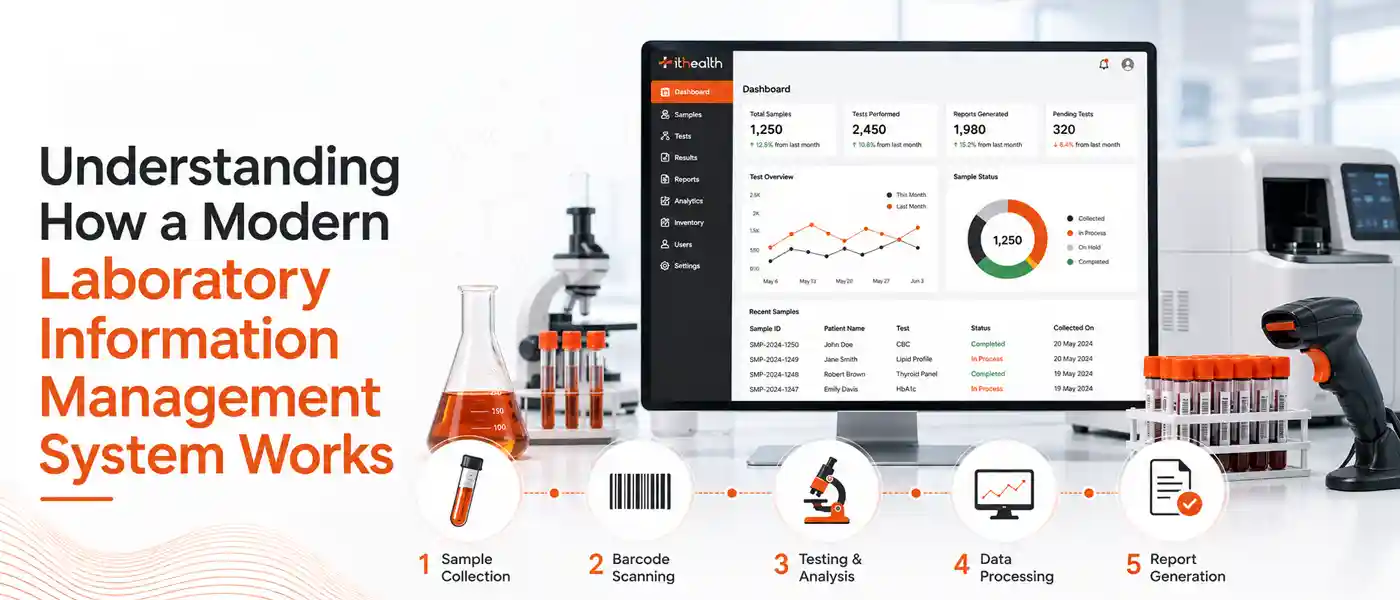
The easiest way to understand a LIMS is to follow one patient through it.
The patient arrives. Their information is entered.
The required tests are added to the record.
A sample is collected and linked to that record.
The sample moves through the laboratory.
Results are entered against the relevant tests.
The system applies the configured information needed for reporting.
A report is generated using the appropriate template.
The report is reviewed and approved.
It can then be delivered to the patient through the chosen channel.
None of these individual steps is particularly mysterious. The interesting part is that they are connected.
That connection is really the heart of a modern laboratory platform.
A LIMS is not simply a place where a laboratory stores patient details. It is a system for moving information through a series of connected processes while keeping the relationship between the patient, sample, test, result and report intact.
That is also why the technical side of laboratory software matters even when users never see it.
The interface may look like a few forms, buttons and screens. Underneath, there is structured data, workflow logic, permissions, templates, automation and integrations working together.
And when all of those pieces work properly, the technology becomes surprisingly easy to ignore.
For the laboratory staff using it every day, that is probably the best outcome. They don’t need to think about databases or workflows every time they register a patient. They simply need the right information to be in the right place when they need it.
The complicated part is what happens behind the screen.
Conclusion
A modern LIMS may look simple from the user’s side, but there is a considerable amount happening behind the screen. Patient records, samples, tests, results, reports, permissions, automation and communication channels all have to work together seamlessly.
The real value of a LIMS lies in this connection. By keeping information structured and moving it through a defined workflow, a laboratory can reduce repetitive work, improve visibility and make reporting more efficient without taking professional judgement out of the process.
Ultimately, good laboratory software should not make the workflow feel more complicated. It should make the complexity almost invisible. When the right information reaches the right person at the right time, the technology has done its job well.

