
It begins with what seems like a minor complaint. A middle-aged farmer from a small village had been feeling unusually weak for days. With the nearest physician almost 150 kilometres away, his local pathology lab was his only hope for finding answers quickly.
His blood sample was collected without delay. But the laboratory was still dependent on handwritten registers, manual report preparation, and paper files. A simple transcription error and a delayed report meant that by the time his doctor received the results, several precious days had slipped away.
Those lost days could have been spent meeting a specialist, starting treatment, or preparing for further investigations.
Stories like this unfold every day in remote towns and villages. While advanced hospitals may be far away, pathology laboratories are often the first and most important step in a patient’s healthcare journey. The faster a diagnosis is confirmed, the sooner a patient can make informed decisions about treatment.
That is exactly why more laboratory owners today are asking how to improve lab efficiency using software.
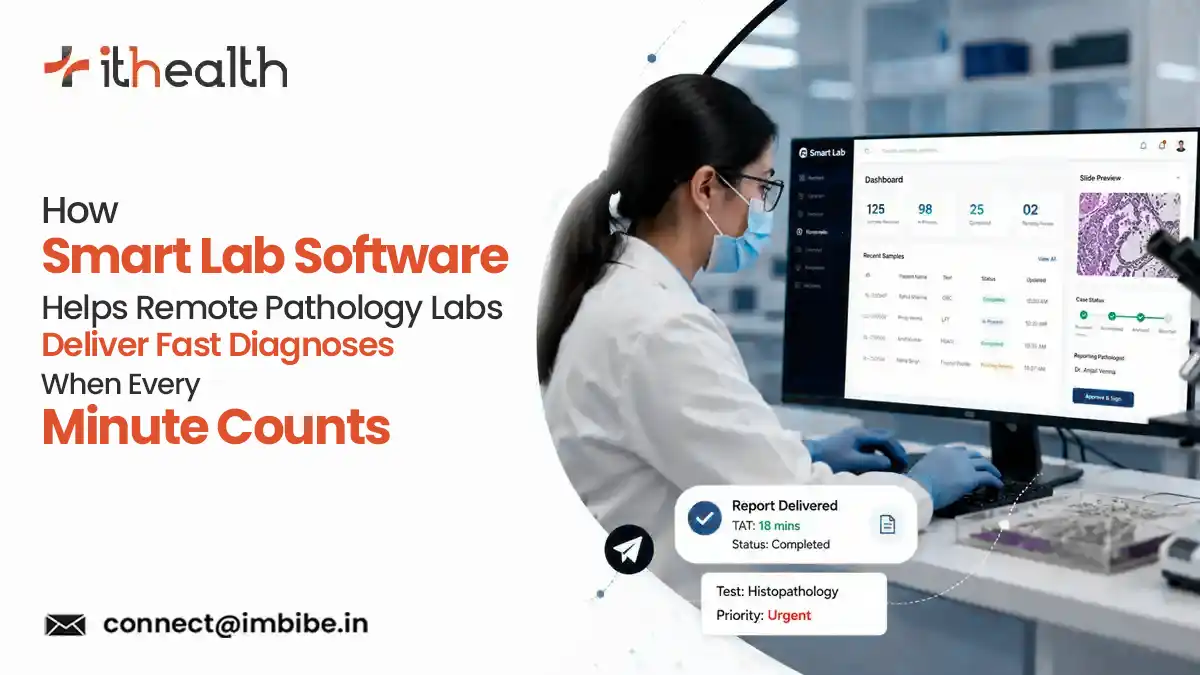 The Everyday Challenges of Small Pathology Labs
Running a small pathology laboratory is not easy. Most labs operate with limited manpower. A single technician may be responsible for registering patients, collecting samples, preparing reports, managing billing, answering phone calls, and even explaining reports to anxious families.
Despite working tirelessly, manual processes often slow everything down and subsequently chances of error increase.
Everyday hassles like, patient details may need to be entered repeatedly. Reports are prepared manually. Old records can be difficult to retrieve. Even a small typing mistake can result in unnecessary confusion.
When the workload increases, delays and errors become almost inevitable.
For someone living in a metro city, waiting another day for a report may simply be inconvenient. For someone travelling from a remote village, that extra day could mean another long journey, another day’s wages lost, or another postponement in receiving critical medical care.
In healthcare, every hour truly matters.
How Technology Makes Life Easier—for Labs and Patients
Digital transformation is no longer reserved for large diagnostic chains.
Today’s Laboratory Information Management Systems (LIMS) are designed to help even small laboratories work smarter without making daily operations more complicated.
Instead of spending hours on paperwork, laboratories can automate routine activities like patient registration, sample tracking, report generation, billing, and record management.
Reports become easier to prepare, patient histories are available instantly, and the chances of manual errors reduce significantly. Thereby exponentially increasing the efficiency of the lab.
Most importantly, technicians get back what they often lack the most—time. Time to verify reports carefully. Time to focus on accuracy and most importantly time to serve patients better.
That is one of the biggest reasons laboratories are exploring how to improve lab efficiency using software.
Why Faster Reports Can Change Patient Outcomes
Let us think about a patient being tested for dengue during monsoon season. Or maybe someone showing symptoms of sepsis. Or an elderly patient whose thyroid levels need immediate evaluation.
In such cases, waiting an extra two or three days for a report isn’t just frustrating, it can also delay treatment when it matters most.
When reports reach doctors quickly, patients can immediately schedule specialist consultations, begin medication sooner, arrange travel to larger hospitals if needed, and avoid unnecessary complications.
For families living in remote locations, a timely pathology report often becomes the difference between early intervention and delayed treatment.
It’s pertinent to note here that technology cannot diagnose patients. Doctors do that. But technology can ensure that doctors receive accurate information exactly when they need it.
Choosing Software That Fits Small Laboratories
Many laboratory owners hesitate before adopting digital systems. Some worry that software will be expensive. Others assume it will be difficult for staff to learn the tech involved in using it. Thus the question becomes: Which software is suitable for small pathology labs.
The right solution should feel like an extra team member—not another responsibility.
It should be easy to use, affordable, secure, cloud-based, and capable of growing alongside the laboratory. It should simplify report generation, safely store patient records, reduce repetitive work, and offer dependable customer support whenever assistance is needed.
Good software should make the workday lighter, not more complicated.
How ItHealth by Imbibe Tech Supports Modern Laboratories?
This is where ItHealth by Imbibe Tech makes a real difference.
Designed specifically for pathology and diagnostic laboratories, ItHealth replaces time-consuming manual work with an efficient digital workflow. From patient registration and billing to report generation and record management, every stage becomes faster, more organized, and easier to manage.
Its Smart Report Engine automatically applies reference ranges, flags critical values, and generates professional reports in just a few clicks. Laboratories can securely access patient records through the cloud while sharing reports instantly through Email, SMS, or WhatsApp.
Instead of spending valuable hours on administrative tasks, laboratory teams can focus on what truly matters—delivering accurate diagnoses with confidence.
Digital Transformation Is About Better Patient Care
Healthcare is evolving rapidly. And patients today expect faster reports. Doctors expect reliable diagnostic data and in turn laboratories are expected to deliver both while managing increasing workloads.
Understandably, relying solely on manual processes makes it difficult to meet these expectations consistently.
Digital laboratory software isn’t just about adopting a new technology; it’s about building a system that helps laboratories work more efficiently without compromising quality.
Even a small pathology laboratory in a rural town can now provide services equivalent to larger diagnostic centres.
A Small Change That Creates a Bigger Impact
Every pathology report tells someone’s story. It could be a child waiting to know the cause of a persistent fever. A pregnant woman monitoring her and her foetus’ health. An elderly patient hoping for reassurance. Or a daily wage worker trying to understand why he feels exhausted.
Behind every report is a person waiting for answers.
When laboratories become faster and more efficient, patients receive those answers sooner. Doctors can act earlier, treatments can begin without unnecessary delays, and families gain valuable time when every moment matters.
If you’re still wondering how to improve lab efficiency using software, the answer lies in choosing technology that supports both your laboratory team and the patients who depend on you.
And if you’re asking which software is suitable for small pathology labs, look for a solution that is affordable, intuitive, scalable, and built around the realities of everyday laboratory operations.
Because in healthcare, improving efficiency isn’t only about saving time. More-often-than-not, it’s about helping save lives.

